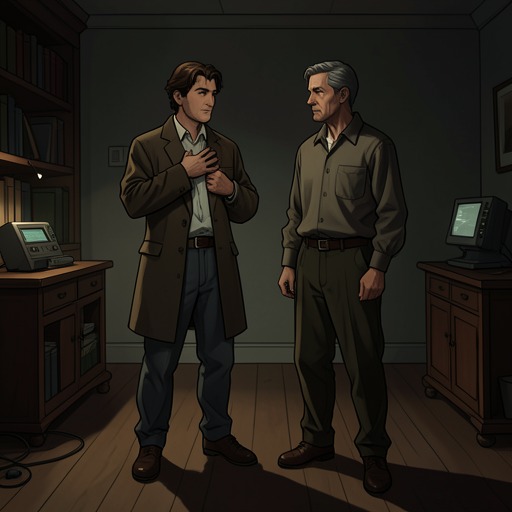
Kirsten investigates Charlie and Jeremy’s disappearance
Station ElevenKirsten Raymonde investigates the disappearance of Charlie Harrison and Jeremy Leung after reaching St. Deborah by the Water, where the couple had once been her companions. The search moves from imagined reunion to a graveyard where their names appear among the dead, then reverses again when Kirsten sees that no one is buried beneath their markers. The evidence establishes that Charlie and Jeremy left town, but not where they went or what prompted their departure. Its unresolved ending makes the investigation less a solution than a painful lesson in how little names, appearances, and silence can prove in the post-collapse world.
Background and the Search
Kirsten’s search begins with a simple decision: she will walk through town to see whether she can find Charlie. She goes alone. The quest carries the weight of more than two years spent travelling apart from the friend she had once known in St. Deborah by the Water. Kirsten has rehearsed what a reunion might look like: Charlie at the door with a baby, tears and laughter, and the familiar sixth guitar beside her. The imagined welcome gives the search an emotional destination before Kirsten has any facts about what happened.
The town offers no easy path to that reunion. At the Wendy’s, Kirsten pauses over a replacement front door of solid wood, carved with flowers beside its handle. The careful workmanship invites a touch and a knock; the door seems to hold out the promise of a personal welcome. But the woman who answers is unfamiliar. Kirsten asks for Charlie, and the woman shows no recognition. A midwife later recognizes Kirsten as a member of the Travelling Symphony, but her answer is only that Charlie and Jeremy left town. When Kirsten asks why and where they went, neither the midwife nor the other woman answers.
That refusal to explain leaves Kirsten with a report but no account. The pair’s departure is not yet proof of death, but the silence around it makes the possibility difficult to dismiss. Kirsten’s search has to proceed through scraps of information and gestures rather than a reliable record of their lives. The contrast between the welcoming door she imagined and the guarded, incomplete answers she receives begins the investigation’s central pattern: apparent signs invite certainty, then fail to supply it.
The Markers in the Graveyard
Dieter leads Kirsten away from the road, past the overgrown foundation of a building begun just before the Georgia Flu, toward the town’s expanded graveyard. There are perhaps three hundred graves, arranged in neat rows between the unfinished site and the forest. In the newest section, freshly painted white markers catch the eye. From a distance, Kirsten can read the names, and their appearance brings her search to its worst apparent conclusion.
Three markers stand together in the afternoon shadows. They bear the names Charlie Harrison, Jeremy Leung, and Annabel, their infant daughter. Each gives the same date: July 20, Year 19. Kirsten reacts with horror. The names, grouped as a family and given a shared date, seem to tell a complete and devastating story before she can question it. For a moment, the grave markers appear to answer what the town’s inhabitants would not.
Dieter insists that the three are not buried there and directs Kirsten to examine the ground. The distinction is visible: the earth beneath their markers is flat and undisturbed, unlike the mounded soil over the actual graves at the older end of the cemetery. The same irregularity appears elsewhere. A cluster of thirty graves bears dates within a two-week span, consistent with an illness that spread quickly in winter; beyond that cluster, some markers stand over graves while others do not. The names of Charlie, Jeremy, and Annabel have been set among the dead without bodies beneath them. The evidence overturns Kirsten’s first interpretation, but does not explain who placed the markers or why they chose that date.
A Witness, but No Account
After the graveyard encounter, Kirsten identifies a girl who has been watching and asks whether she knew Charlie and Jeremy. The girl’s first response is nearly imperceptible: a small nod. Kirsten gestures toward the markers and asks whether the couple are dead. The girl quietly says that they left. Her answer supports what the woman in town had said, and confirms that the empty markers should not be read as proof that Charlie, Jeremy, and Annabel died there.
The girl does not say when they left, where they went, or why the names were placed in the cemetery. When Kirsten tries to ask when, the girl loses her nerve and runs behind the unfinished foundation. Kirsten is left with Dieter, the graveyard, and the forest; neither of them has anything to say. The encounter yields one firm fact, that the family left, while preserving the questions that had driven the search. The girl’s fear is evidence of the difficulty of asking, not an explanation of what happened.
Uncertainty and the Post-collapse World
The investigation takes place in a world where the loss of communications is not a metaphor alone. The Internet has disappeared along with social media: the everyday stream of photographs, messages, plans, pleas, and small updates that once let people feel less alone. In Traverse City, an inventor pedals a stationary bicycle to power a laptop, hoping to find the network; the screen instead displays the message that the webpage is unavailable. Electricity can still be imagined and briefly produced, but the connections people once expected it to restore remain out of reach.
Against that background, Kirsten’s search depends on face-to-face testimony and physical traces: a door, a hesitant answer, names painted on wood, and the condition of the soil beneath them. Each clue needs interpretation, and even the most striking one—the shared date on three markers—proves misleading when compared with the ground. The episode does not reveal Charlie and Jeremy’s destination or settle their fate beyond their departure. Its significance lies in the distance between finding evidence and knowing what it means: Kirsten can correct the assumption that the markers are graves, but she cannot turn the town’s silences into a full account of her friends’ lives.